
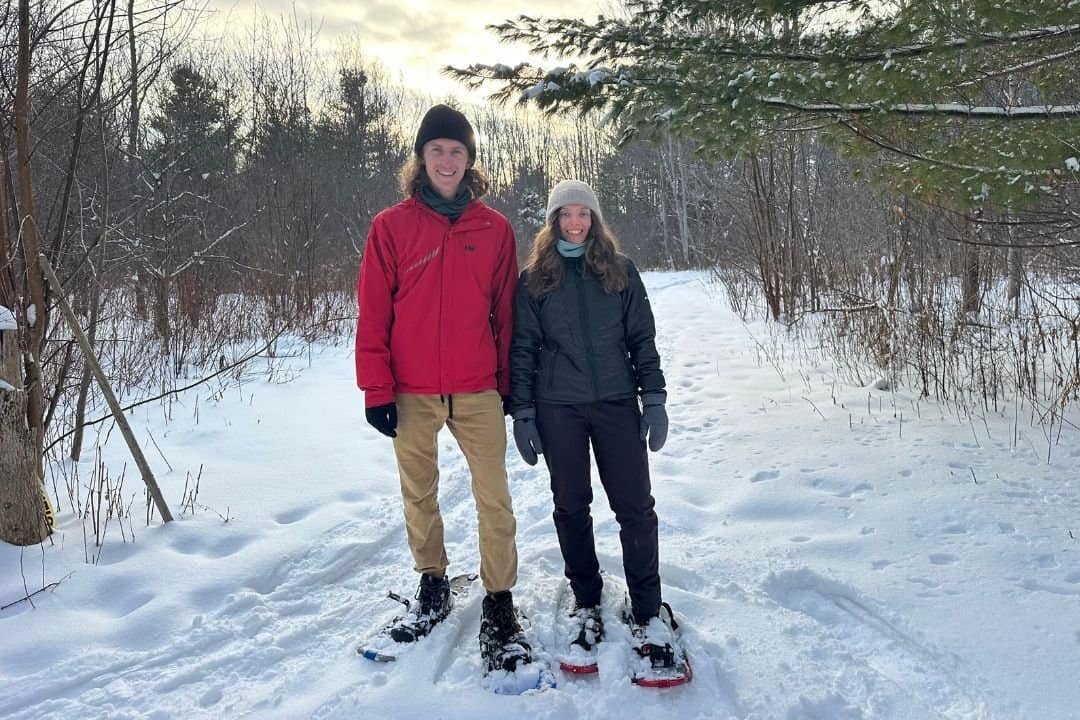
Snowshoes for beginners are one of the simplest winter gear I’ve used. Not only is it a great way to get into nature in the winter, but an easy outdoor sport to get into. I have been grateful to snowshoes on Canadian forest trails in deep snow. For a first pair, choose a trail snowshoe with a binding you can work in mittens, sized to your weight with gear on. The MSR Evo Trail is the pair we’d hand to a friend to get started. Also, length matters more than brand: a 22 in (56 cm) trail shoe carries about 180 lb (82 kg). If you go over that, you sink, which is the beginner’s number one complaint.
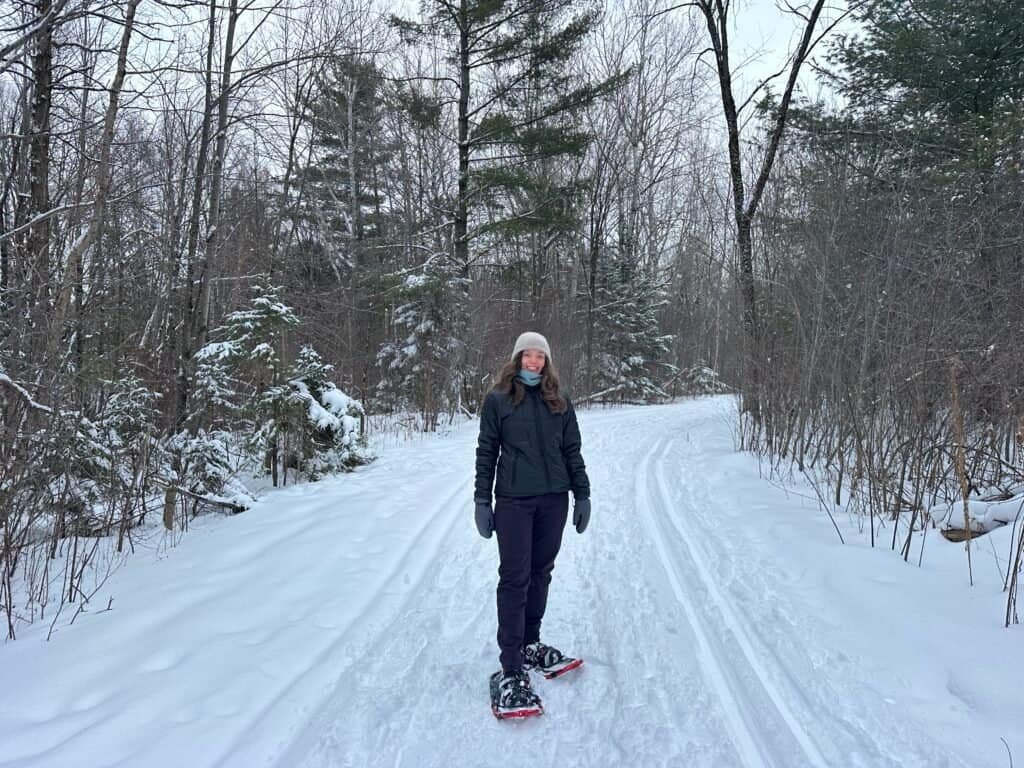
I have snowshoed a lot in Canada, mostly on forest trails after a big snowfall. It was one of my favorite family activities and it was such a lovely experience to venture into the forest without sinking into the snow. I never used poles. Now that I live in the Austrian Alps, there is much less snow in the valley where I live, but nothing beats a hike in fresh snow.
In this guide you will find eight pairs of snowshoes for beginners and beyond. The MSR Evo Trail is our top pick for its grippy steel rails and a binding you can close in mittens. Then come a budget pair, a lightweight pair and two backcountry models for when the trails get steep. Below the picks you’ll find a sizing table and what to wear, and our ski essentials guide covers the rest of a winter in the mountains.
The Best Snowshoes at a Glance
Compare the picks
| Pick | Length | Rated load | Best for |
|---|---|---|---|
| MSR Evo Trail | 22 in (56 cm) | 180 lb (82 kg) | Packed and rolling trails |
| Retrospec Drifter | 21 in (53 cm) | 120 lb (54 kg) | First winter, flat trails |
| MSR Lightning Ascent | 25 in (64 cm) | 220 lb (100 kg) | Steep and icy backcountry |
| MSR Women’s Lightning Ascent | 25 in (64 cm) | 220 lb (100 kg) | Steep terrain, narrow stride |
| Tubbs Women’s Flex VRT | 25 in (64 cm) | 242 lb (110 kg) | Rolling hills, mixed snow |
| Crescent Moon Trailhawk 27 | 27 in (69 cm) | 195 lb (88 kg) | Long days, fast walkers |
| Tubbs Men’s Flex STP | 28 in (71 cm) | 190 lb (86 kg) | Local trails on a budget |
| Tubbs Women’s Flex STP | 22 in (56 cm) | See brand chart | Local trails on a budget |
The 8 best snowshoes for beginners and beyond
MSR Evo Trail
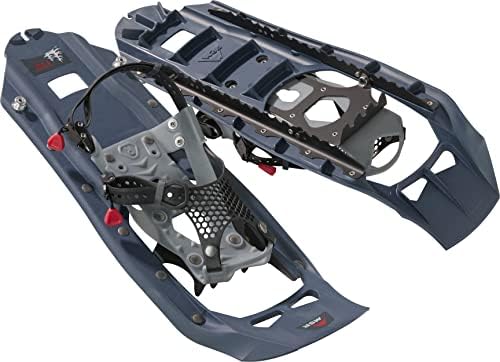
The Evo Trail earns the top spot because it does the two things a first pair must do. It grips on packed and icy trails, and it goes on and off with your mittens on. The one-piece molded deck has steel traction rails along both edges and a steel crampon under the toe, so you stay planted on a sidehill. The Paraglide binding is a stretch mesh that hugs almost any boot, from light hikers to snowboard boots.
It is a trail snowshoe, not a powder shoe. One thing to note: the 22 in (56 cm) deck carries 180 lb (82 kg) with your pack on. In deep, soft snow you will want MSR’s add-on tails for more float. Also, buyers mention the deck is close to indestructible and the straps are easy in gloves.
- Material
- alloy steel, plastic (molded deck, steel rails)
- Length
- 22 in (56 cm)
- Weight
- 3 lb 10 oz (1.64 kg) per pair
- Rated load
- 180 lb (82 kg)
- Binding
- Paraglide stretch mesh, glove-friendly straps
- Heel lift
- no
- Fits
- shoe sizes men’s 3 to 13, women’s 5 to 15
- Best for
- packed and rolling trails, a first pair that lasts

Retrospec Drifter
The Drifter is the pair for anyone who wants to try snowshoeing this winter without spending much. It still has the heel lifts and ratchet bindings that cheap pairs often skip. The aluminum frame keeps it light, the two ratchet straps close fast with gloves on, and a mesh carry bag is in the box.
We did notice that the 21 in (53 cm) size carries only 120 lb (54 kg), so most adults need one of the longer lengths. The crampons are smaller than on the MSR and Tubbs pairs. Keep it for flat and rolling trails rather than icy climbs. Buyers mention the ratchets can stiffen in the cold until they are broken in.
- Material
- aluminum (frame)
- Length
- 21 in (53 cm); longer lengths available
- Weight
- 5.5 lb (2.5 kg) per pair
- Rated load
- 120 lb (54 kg) at 21 in
- Binding
- double ratchet straps
- Heel lift
- yes
- Includes
- mesh carry bag
- Best for
- a first winter on flat and rolling trails

MSR Lightning Ascent
The Lightning Ascent is the pair for steep, icy ground. The whole frame is a serrated edge that bites in every direction, instead of a single crampon under the toe. The Paragon binding is one wide strap that wraps the boot without pressure points. The Televator heel bar flips up with a pole tip or a glove for long climbs.
One factor to consider is the price. This is a mountaineering snowshoe, and on groomed and forest trails the Evo Trail does the job for far less. It is made in the USA. The 25 in (64 cm) size carries 220 lb (100 kg) before you add the optional tails.
- Material
- plastic deck, alloy steel frame
- Length
- 25 in (64 cm); other lengths available
- Weight
- 4 lb 5 oz (1.96 kg) per pair
- Rated load
- 220 lb (100 kg)
- Binding
- Paragon one-piece strap
- Heel lift
- yes, Ergo Televator
- Fits
- men’s shoe sizes 4.5 to 15
- Best for
- steep, icy and alpine terrain

MSR Women's Lightning Ascent
The women’s Lightning Ascent has the same bite-everywhere frame as the men’s, on a narrower, tapered deck. That suits a shorter stride, which at 5’2″ (157 cm) is exactly what I want on a traverse. It is a little lighter than the men’s at 4 lb (1.83 kg) per pair, with the same Paragon strap and flip-up heel bar.
The catch is the same as on the men’s and on forest loops it is more shoe than you need. We link the 25 in (64 cm) length, which suits most women with a pack.
- Material
- plastic deck, alloy steel frame
- Length
- 25 in (64 cm)
- Weight
- 4 lb (1.83 kg) per pair
- Rated load
- 220 lb (100 kg)
- Binding
- Paragon one-piece strap
- Heel lift
- yes, Ergo Televator
- Fits
- women’s shoe sizes 4.5 to 14
- Best for
- steep terrain and narrow strides

Tubbs Women's Flex VRT
The Flex VRT is the women’s pair for hilly trails, because its deck twists with your foot on uneven ground instead of fighting it. The Boa dial binding tightens evenly around the boot with one hand. The carbon steel toe crampon is aggressive enough for icy climbs, and the 19-degree heel lift takes the sting out of long ups.
Keep in mind that the Boa dial, easy as it is in mittens, is one more mechanical part to look after. Just knock the ice off before you turn it. The 25 in (64 cm) deck carries 242 lb (110 kg), generous for a women’s shoe, so most of us can carry a full pack on it.
- Material
- aluminum, alloy steel frame
- Length
- 25 in (64 cm)
- Rated load
- 242 lb (110 kg)
- Binding
- DynamicFit with Boa dial
- Heel lift
- yes, 19 degrees
- Crampon
- Viper 2.0 carbon steel
- Best for
- rolling hills and mixed snow

Crescent Moon Trailhawk 27
The Trailhawk is the pair for long days. Its teardrop shape lets you walk with a normal stride instead of the wide waddle most snowshoes force on you. The Spin binding closes with one dial, on and off in seconds, and the heel lift is built in. At 27 in (69 cm) it floats well for its weight.
Sizing is the one limit. It comes in one size for men and women up to 195 lb (88 kg), and the binding fits women’s 6 to men’s 11.5. Very small or very large feet should look elsewhere.
- Material
- aluminum, stainless steel
- Length
- 27 in (69 cm)
- Weight
- 3 lb 11 oz (1.68 kg) per pair
- Rated load
- 195 lb (88 kg)
- Binding
- Spin dial, one size
- Heel lift
- yes
- Fits
- women’s 6 to men’s 11.5
- Best for
- long days and a natural stride

Tubbs Men's Flex STP
The men’s Flex STP is the pair for local trails on a budget, from a brand that has made snowshoes for more than a century. The Quick Pull binding cinches with one strap and opens with one buckle. The tail flexes so your stride rolls naturally, and the curved traction rails hold on icy sidehills.
The trade-off is the missing heel lift, so steep climbs will work your calves more than on the Flex VRT. The 28 in (71 cm) size carries 190 lb (86 kg). It is a plain trail shoe rather than a backcountry one, which for most of us is exactly the point.
- Material
- plastic deck, aluminum frame
- Length
- 28 in (71 cm)
- Rated load
- 190 lb (86 kg)
- Binding
- Quick Pull strap
- Heel lift
- no
- Crampon
- curved traction rails
- Best for
- local trails, a budget first pair for men

Tubbs Women's Flex STP
The women’s Flex STP is the pair I’d point a friend to for her first winter of forest loops. The shorter 22 in (56 cm) deck is easy to turn, and it has the same one-strap Quick Pull binding as the men’s. There is a flex tail that softens each step, the curved rails grip well on packed snow, and the pair weighs about 3.5 lb (1.6 kg).
It’s worth knowing that no rated load is given for this length, so use the Tubbs chart and size up if you carry a pack. No women’s pair in your size? The men’s 28 in (71 cm) Flex STP suits anyone over about 150 lb (68 kg).
- Material
- aluminum
- Length
- 22 in (56 cm)
- Weight
- 3.5 lb (1.6 kg) per pair
- Rated load
- see the brand’s chart
- Binding
- Quick Pull strap
- Heel lift
- no
- Best for
- a first pair for women on packed trails
How we picked
For me, a snowshoe has one job: let you walk through deep snow without sinking. During winters in Canada I loved going to forest trails after a snowfall. One of the easiest low-prep winter sports. I just needed the snowshoes, so there were no poles and no fuss. That is the feeling I wanted every pair here to give a beginner. So the binding came first. It has to close and open with mittens on, because cold fingers on a frozen buckle end a walk faster than any hill!
After that came length and rated load, since the wrong size is the reason first-timers sink. Snowshoes are aluminum, steel and molded plastic, so the natural-fiber rule we use for clothing doesn’t apply here. Every pick on this list comes from a maker that has built snowshoes for years. The one true budget pair in the list is one we’d be happy to strap on to go on a winter trail too. You can read more about how we choose gear.
What to look for in snowshoes for beginners
Terrain:
Flat and packed trails need a plain trail shoe with light traction, like the Evo Trail or the Flex STP. When it comes to rolling hills, I want a heel lift and bigger crampons, like the Flex VRT. Steep or icy backcountry wants an edge that bites all round, which is what the Lightning Ascent is for.
Length by weight:
Your weight with boots, clothes and pack decides the length, not your shoe size. Typical ranges are below. The brand’s own chart wins if they differ.
| Your weight with gear | Typical length |
|---|---|
| Up to 150 lb (68 kg) | 20 to 22 in (51 to 56 cm) |
| 150 to 200 lb (68 to 91 kg) | 22 to 25 in (56 to 64 cm) |
| 200 to 250 lb (91 to 113 kg) | 25 to 30 in (64 to 76 cm) |
| Over 250 lb (113 kg) | 30 to 36 in (76 to 91 cm) |
Deep, soft powder pushes you up a size. Then, packed trails let you stay small and nimble.
Binding:
On snowshoes for beginners, a binding you can work in mittens is worth more than any other feature. Stretch mesh, one wide strap or a Boa dial all pass that test. Lots of thin straps and small buckles don’t. The ones you fumble at -15°C (5°F) are the ones you’ll stop using.
Heel lift:
A small bar that flips up under your heel on climbs. Skip it for flat trails, want it for anything hilly.
What to wear with snowshoes:
Waterproof, insulated boots with a sole the binding can grip work best. I wear either ankle hiking boots or my winter boots. Check out our guide to women’s snowshoe boots that covers the pairs we like. If you walk in minimal shoes year round, our barefoot winter boots guide shows which ones take a binding. Under the boots go merino wool socks, and under the shell a merino base layer. Snowshoeing is harder work than it looks, and you’ll be warm within ten minutes. Gaiters keep the snow out of your boots on deep days.
FAQs
Snowshoes are wide frames you strap to your boots so your weight spreads over more snow and you stay on top. The deck gives you float, the crampon and rails give you grip, and the binding ties it all to your boot. A bigger deck floats more; sharper traction holds better on ice.
Size by your weight with boots, clothes and pack, not by shoe size. Most adults under 200 lb (91 kg) land on 22 to 25 in (56 to 64 cm). Heavier walkers and deep powder push you to 30 in (76 cm) or more, and the maker’s chart has the final say.
Waterproof insulated boots, merino socks, a merino base layer, a light mid layer and a shell. Snowshoeing is hard work, so start a little cool: you’ll be warm within minutes. Also, gaiters and warm, waterproof gloves finish the kit on deep or windy days.
Strap in, stand up and walk with a slightly wider stance than normal so the frames don’t clip each other. Lean into the toe crampon on climbs and sit back a touch on descents. On a sidehill, kick the uphill edge in before you commit your weight.
Set the snowshoe flat and put the ball of your foot over the crampon. Close the toe strap or dial first, then the heel strap, and give each a tug. Check them again after ten minutes, because straps settle once you start walking. Do it with your mittens on so you know it works in the cold.
No, you don’t need poles on flat trails. I’m a beginner myself, I’ve stuck to mostly flat forest loops and I don’t use them. They help on hills and in deep powder, where a tip to push off keeps your balance. A pair of ski poles with snow baskets does the job.