
A ski bag is a long zippered sleeve, padded or plain, that carries one or two pairs of skis with their poles, so the edges and bases arrive without scratches and nobody on the bus gets clipped. This matters most the day you fly, as airlines check skis as sports equipment, and with Air Canada, for one, a boot bag holding only boots, helmet and goggles travels free alongside your ski bag, so the pair counts as a single checked item.
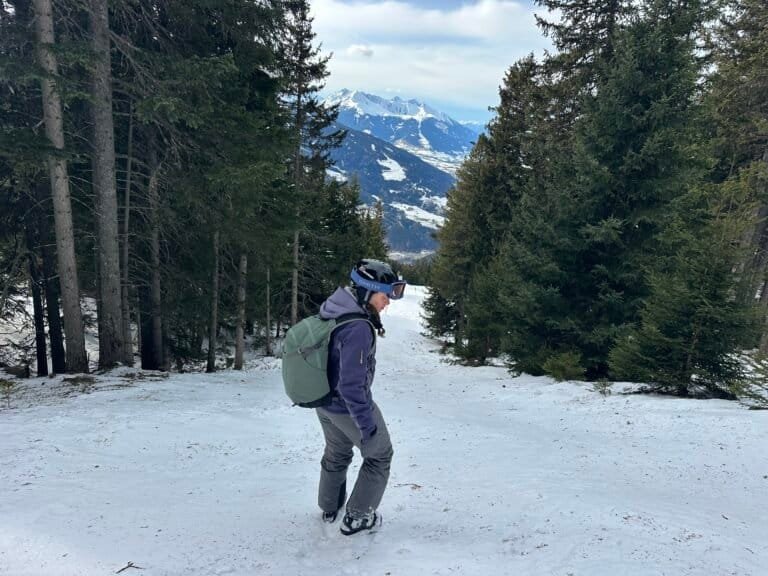
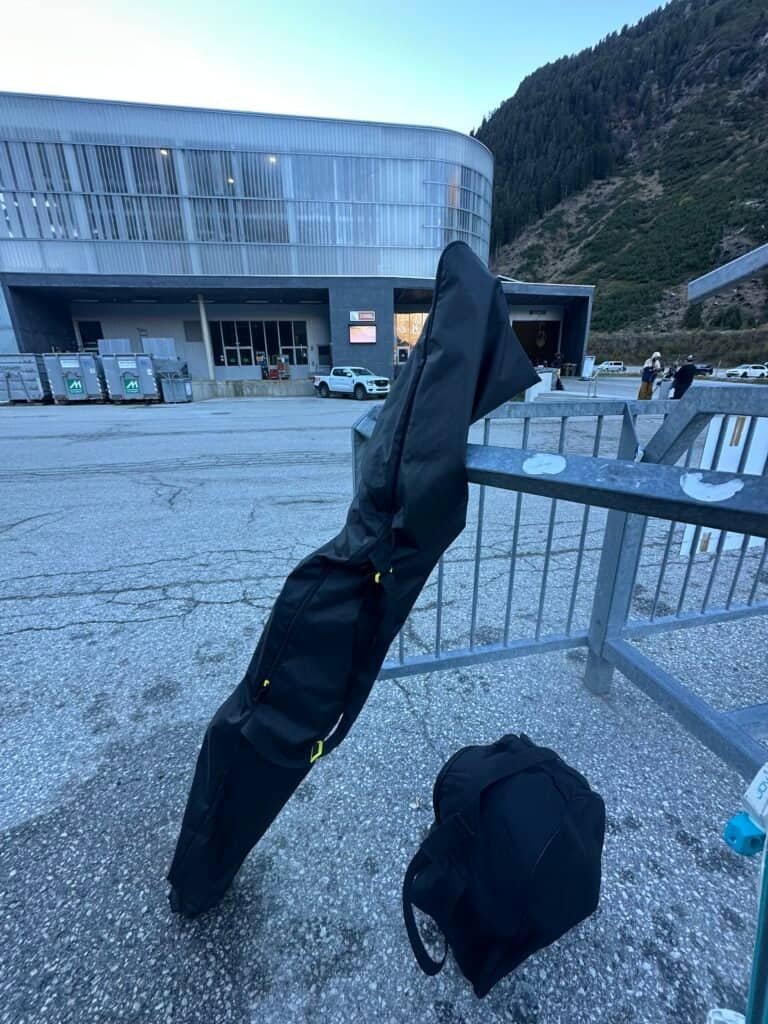
For me, the ski bag is half of a two-bag setup I have refined over a few runs to the hill. I live a 20 minute bus ride from the nearest ski hill in the Austrian Alps, and after our first trips dealing with skis flinging around the bus, my boots, helmet and goggles went into a boot backpack and the skis went into a single, unpadded ski bag with no wheels. My husband’s skis and poles fit in there with mine. Mine go in first because they are shorter and smaller, then we can fit them both in tightly. It’s the setup I use for every bus to the slopes now, and it’s definitely a lot less chaotic than carrying two pairs of skis by hand.
Below are 8 ski bags, led by the Athletico padded combo for giving you a padded ski bag and a matching boot bag at the price of a lift ticket, from a plain sleeve for the bus to a wheeled hard case for long-haul flights, plus what to look for, what to know before you fly with skis and the questions readers ask most. For the whole kit, from base layers to goggles, start with our guide to what to wear skiing.
Ski Bags at a Glance
- 1Athletico Padded Ski and Boot Bag ComboCheck price
- 2Dakine Fall Line Ski Roller BagCheck price
- 3Thule RoundTrip Ski BagCheck price
- 4Db Journey Snow Roller Pro 127LCheck price
- 5Sportube Series 2Check price
- 6High Sierra Ski Bag and Boot Bag SetCheck price
- 7Unigear Ski Bag for Air TravelCheck price
- 8Rossignol Basic Ski BagCheck price
| Bag | Type | Fits | Best for |
|---|---|---|---|
| Athletico Combo | Padded, with boot bag | 1 pair to 200 cm | One set for everything |
| Dakine Fall Line | Padded roller | 2 pairs, 175 or 190 cm | Airports |
| Thule RoundTrip | Padded, two sleeves | 2 pairs to 192 cm | Flights without wheels |
| Db Snow Roller Pro | Padded roller, 127 L | Skis, boots, helmet | Everything in one bag |
| Sportube Series 2 | Hard case on wheels | 2 pairs, 48 to 83 in | Long-haul flights |
| High Sierra Set | Plain, with boot bag | 1 pair to 200 cm | First ski bag |
| Unigear Air Travel | Padded all round | 1 pair to 192 cm | Flights on a budget |
| Rossignol Basic | Plain sleeve | 1 pair to 185 cm | The bus and the car |
The 8 Best Ski Bags

Athletico Padded Ski and Boot Bag Combo
The Athletico combo takes the top spot because it solves the whole problem in one box: a padded ski bag for skis up to 200 cm and a matching padded boot bag for boots up to size 13, both lined with 5 mm foam, for less than most single padded bags cost. The roll-top on the ski bag folds down for shorter skis, so a petite skier’s pair sits snug instead of rattling around, and both bags have grab handles and a detachable shoulder strap.
It is a one-pair bag, so a couple needs two sets or a double bag, and the padding is thinner than on the Thule or Dakine, which is why it sits in the car or the bus more often than the hold.
- Material
- 600D water-resistant polyester with 5 mm dense foam padding
- Fits
- One pair of skis up to 200 cm, boots up to US 13
- Padding
- 5 mm foam throughout both bags
- Closure
- Roll-top ski bag, zippered boot bag
- Carry
- Grab handles, detachable shoulder straps
- Best for
- One set for everything
If you’d rather carry your boots on your back, our ski boot bag guide has backpacks and duffels that pair with any of the ski bags here.

Dakine Fall Line Ski Roller Bag
The Fall Line is the roller to pick because it rolls two pairs of skis plus boots, poles and outerwear through an airport on one set of wheels, with a YKK #10 lockable main zipper and a body made from 100% recycled polyester. It is the bag that keeps coming up when readers search for a Dakine ski bag, and it comes in 175 and 190 cm lengths and a run of colors.
At 190 cm it is a long bag to steer through a crowded terminal, and like every roller it is heavier empty than a plain sleeve. Check which length you are buying: the 190 cm takes longer skis but is the one that fills a small car.
- Material
- Body 100% recycled polyester, lining 100% polyethylene
- Fits
- Two pairs of skis plus boots, poles and outerwear
- Lengths
- 175 cm and 190 cm
- Closure
- YKK #10 lockable main zipper (lock not included)
- Carry
- Wheels, grab handles
- Best for
- Airports

Thule RoundTrip Ski Bag
The Thule RoundTrip is the padded pick because each pair of skis gets its own padded, cinch-top sleeve inside the bag, with a separate internal compartment for the poles, so nothing rubs against anything else in the hold. External compression straps stop the load shifting, and a removable padded shoulder strap plus grab handles make it a fair carry for a bag with no wheels. Thule’s materials are bluesign approved.
It is a two-pair bag with no wheels, so a full load on a long airport walk is a workout, and it is a newer bag, so there is little long-term wear to go by yet. It comes in one length, 192 cm; the 175 cm RoundTrip is the wheeled roller.
- Material
- Polyester (bluesign approved)
- Fits
- Two pairs of skis and poles
- Length
- 192 cm
- Padding
- Two padded cinch-top ski sleeves, internal pole compartment
- Carry
- Removable padded shoulder strap, grab handles, compression straps
- Best for
- Flights without wheels

Db Journey Snow Roller Pro 127L
The Snow Roller Pro is the bag for people who want their skis, boots, helmet and outerwear in one wheeled bag: 127 L of space with Db’s rib-cage protection that locks the skis in place, interior mesh pockets for the small things, and a hook that attaches the bag to any Db roller suitcase so the whole trip moves as one piece. Between trips it compresses to about a tenth of its size, which matters in an apartment.
It is the priciest soft bag here, and 127 L packed full is heavy, so check your airline’s weight limit before you fill it. Db covers it with a 2-year warranty.
- Material
- Polyester
- Capacity
- 127 L
- Fits
- Skis or snowboards, boots, helmet and outerwear
- Protection
- Rib-cage padding, interior mesh pockets
- Carry
- Wheels, external handles, roller-bag attachment
- Storage
- Compresses to about 10% of its size
- Best for
- Everything in one bag

Sportube Series 2
The Sportube Series 2 is the hard case because it is a lockable 100% recycled HDPE shell on wheels that adjusts from 48 to 83 in (122 to 212 cm) inside, with padded ends that clamp the tips and tails so the skis cannot move. It takes two pairs of alpine skis or four pairs of Nordic skis with poles and small accessories, and it is the case to choose if your skis are worth more than your flight.
It weighs 12 lb (5.4 kg) empty, stores like a canoe, and the pull handle has to come off and travel inside your carry-on or it can snap in transit. There is no room for boots or a jacket: skis and poles only.
- Material
- 100% recycled HDPE shell, internal padding at both ends
- Fits
- Two pairs of alpine skis or four pairs of Nordic skis, plus poles
- Internal size
- 48 to 83 in long (122 to 212 cm), 11 in wide (28 cm), 6 in deep (15 cm)
- Weight
- 12 lb (5.4 kg)
- Closure
- Lockable latches
- Carry
- Wheels, removable Easy Pull Handle
- Best for
- Long-haul flights

High Sierra Ski Bag and Boot Bag Set
The High Sierra set earns the budget label because it gives you a ski bag for skis up to 200 cm and a boot bag for boots up to size 13 at the lowest price here, with a three-quarter zipper and a fold-over end that shortens the bag for smaller skis. The zippers are self-repairing nylon coil, and the boot bag holds one pair of boots.
There is no padding in either bag, so it is a car and bus set, not a flight set, and the fabric is thinner than the Athletico’s. For a first season, a kid’s skis or a bag that lives in the trunk, that is the point.
- Material
- Polyester, nylon (as the listing states; no percentages given)
- Fits
- One pair of skis up to 200 cm, boots up to US 13
- Closure
- Three-quarter length zipper, fold-over end for shorter skis, self-repairing nylon coil zippers
- Weight
- About 3 lb (1.4 kg) for the set
- Best for
- A first ski bag
Unigear Ski Bag for Air Travel
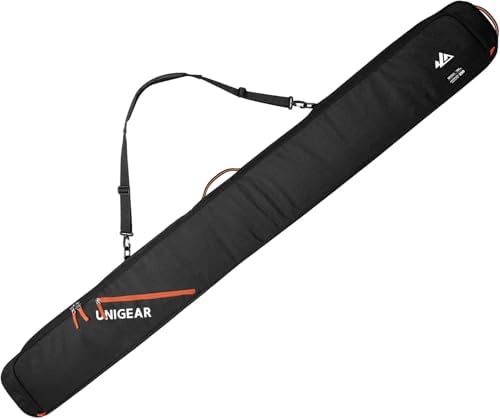
The Unigear is the budget padded bag because it wraps one pair of skis up to 192 cm in dense foam on all sides, with internal compression straps, a separate pole compartment and a waterproof inner lining, for about the price of a plain sleeve from a big brand. The zipper is lockable and opens the full length of the bag, so loading is easy, and the mesh pockets take two light jackets or your layers.
It is a one-pair bag in one size, and the detachable padded shoulder strap is the only way to carry it, so it suits one skier flying once or twice a season rather than a family on the move. The strap and handle are rated to 88 lb (40 kg), which is far more than you will ever put in it.
- Material
- 600D water-resistant polyester, waterproof inner lining
- Fits
- One pair of skis up to 192 cm, internal pole compartment
- Padding
- Dense foam all round, internal compression straps
- Closure
- Lockable full-length zipper
- Carry
- Detachable padded shoulder strap, top and side grab handles
- Best for
- Flights on a budget

Rossignol Basic Ski Bag
The Rossignol Basic is the simple sleeve because it does what a ski bag on a bus needs to do and nothing more: heavy-duty 600D polyester, a full-length zipper and one compression strap, for one pair of alpine skis or two pairs of cross-country skis up to 185 cm. It weighs next to nothing, rolls up in a cupboard and keeps your edges away from other people’s shins.
There is no padding and no boot room, and 185 cm is the limit, so longer skis need the Athletico or Unigear. This is the closest bag here to the plain sleeve I take to the hill: mine can do the bus and the car, but it mostly sees public transport.
- Material
- 600D polyester
- Fits
- One pair of alpine skis or two pairs of Nordic skis, up to 185 cm
- Padding
- None
- Closure
- Full-length zipper, compression strap
- Carry
- Grab handle
- Best for
- The bus and the car
How we picked
We are currently using a tight-fit single ski bag that I take on the bus. However, we are looking to improve that setup. We have asked what each of the others does that our current one doesn’t: padding for the hold, wheels for the terminal, a hard shell for the long haul, a boot bag in the same box. Every pick had to hold a pair of skis with poles without a fight, close with a zipper that would survive a season of slush, and come from a brand that answers when something fails.
Packs and bags are our one exception to the natural-fiber rule, so these are polyester and nylon, chosen for how they are built, not what they are made of, as they are made for function, not to wear on your body. Here is more on how we choose gear.
What to look for in a ski bag
Single or double. Room for your skis and poles is what matters. If you usually ski as two, a double bag like the Thule or Dakine saves a second bag; if you ski alone or with friends who have their own, a single is lighter and easier on the bus. My husband and I squeeze two pairs into my single, which works, but a double would be better. Whichever you pick, a pair of ski straps keeps your skis together inside the bag and gives you a handle for the walk from the lot.
Padded, plain or hard. For the car and the bus, a plain sleeve is enough: it stops scratches and shins. For a flight, padding on all sides or a hard case is what keeps the bases and bindings safe when the bag goes on the belt sideways. Hard cases protect best and weigh and cost the most.
Length. Measure your longest skis and add a little: a 175 cm bag takes most all-mountain skis, a 190 cm bag takes powder and race skis. A roll-top or fold-over end (Athletico, High Sierra) lets a petite skier use a long bag without the skis sliding around. Poles should fit alongside the skis or in their own sleeve; check the length of your ski poles against the bag before you buy.
Wheels. Worth it the moment you have more than one pair or a long walk through an airport. Not worth it for the bus, where a wheeled bag is a tripping hazard and the wheels add weight you carry up the steps.
What goes with it. Boots, helmet and goggles travel in a boot bag, and on the hill itself a thin ski backpack carries your water, snacks and a layer on the lift. The ski bag stays in the car, the locker or the apartment until the ride home.
Flying with skis
Airlines differ, so check yours before you pack. Air Canada counts a boot bag as free when it flies with your skis and holds only ski equipment such as boots, helmet and goggles; put anything else in it and it becomes a second checked piece. Whatever your airline, the weight limit still applies, so a padded two-pair bag packed with boots and jackets can tip over it.
FAQs
Yes if you are buying your first bags or kitting out a family, because a combo set like the Athletico or High Sierra costs about what one padded ski bag costs and keeps wet boots out of the ski bag. The trade-off is that the boot bag in a combo is a simple carry bag, not a backpack: if you take the bus to the hill, a boot backpack plus a single ski bag is the setup I use, and it is easier on your hands.
A ski bag is checked as sports equipment, and the rule that matters is your own airline’s: most publish a skis and snowboards page that says whether the ski bag counts as your standard checked bag and what the weight limit is. Air Canada lets a boot bag with only boots, helmet and goggles fly free alongside the ski bag, so the two count as one item. Check your airline’s sports equipment page before you pack, weigh the bag full, and keep clothes in your suitcase.
Wheels if you fly with two pairs or walk far through airports; no wheels if you mostly drive or take the bus. A roller is heavier empty and harder to store, while a plain or padded sleeve with a shoulder strap is lighter, cheaper and easier to carry up the steps of a bus.
For flights, yes: padding on all sides, or a hard case, protects the bases and bindings when the bag gets thrown on the belt. For the car and the bus, a plain sleeve does the job, which is why the bag I take to the hill is unpadded. Padded bags cost more and take more room in a cupboard.
Strap the skis base to base with ski straps so the edges can’t rub, slide them in tips first, lay the poles alongside or in their sleeve, and cinch the compression strap. For a flight, wrap a layer or a towel around the bindings and put socks over the tips; on a two-pair bag, keep each pair in its own sleeve.
Buy for your longest skis: a 175 cm bag takes most all-mountain skis, a 190 to 200 cm bag takes powder and race skis, and a roll-top or fold-over end shortens the bag for shorter skis. A single bag holds one pair with poles; a double holds two pairs and sometimes boots and outerwear too.