
Ski poles may be the last part of your kit that you are on the lookout for. They tend to be the bit of gear nobody thinks about until a crash bends one. The right pair sets the tone of every turn: essentially they are two aluminum or carbon tubes you plant to time the turn, push you along flat terrain and help you get up after a fall. The quick sizing check is the one every ski shop uses: flip the pole upside down, grab it under the basket, and your elbow should sit at about 90 degrees. The eight poles in this guide come in lengths from 105 to 145 cm (41 to 57 in), so there is a size here for almost every adult.
I always ski with the shortest poles I can get away with for my height. I like to get down low in the turn and plant late, and a little bend in the pole feels good and looks the part. Growing up skiing every season in Canada, I bent one that way, landing on it after a jump, and when my neighbor kindly offered to bend it back into shape, the inevitable happened. Snap! In the park I ski without poles now, after too many days of watching them go flying or landing on one. If you want them for the run-in, slip your hands out of the straps before the jump line, so a pole can’t drag your arm when you land. On days I board in the morning and ski after lunch, I leave the poles in the car.
Below are our eight picks, led by the LEKI Detect S for its 16 mm aluminum tube, detachable Trigger S strap and two sets of baskets, plus a budget pick, two women’s poles and one adjustable pole for touring. You also get a ski pole size chart, what to look for and the questions skiers ask most. For the rest of your kit, start with our ski essentials guide.
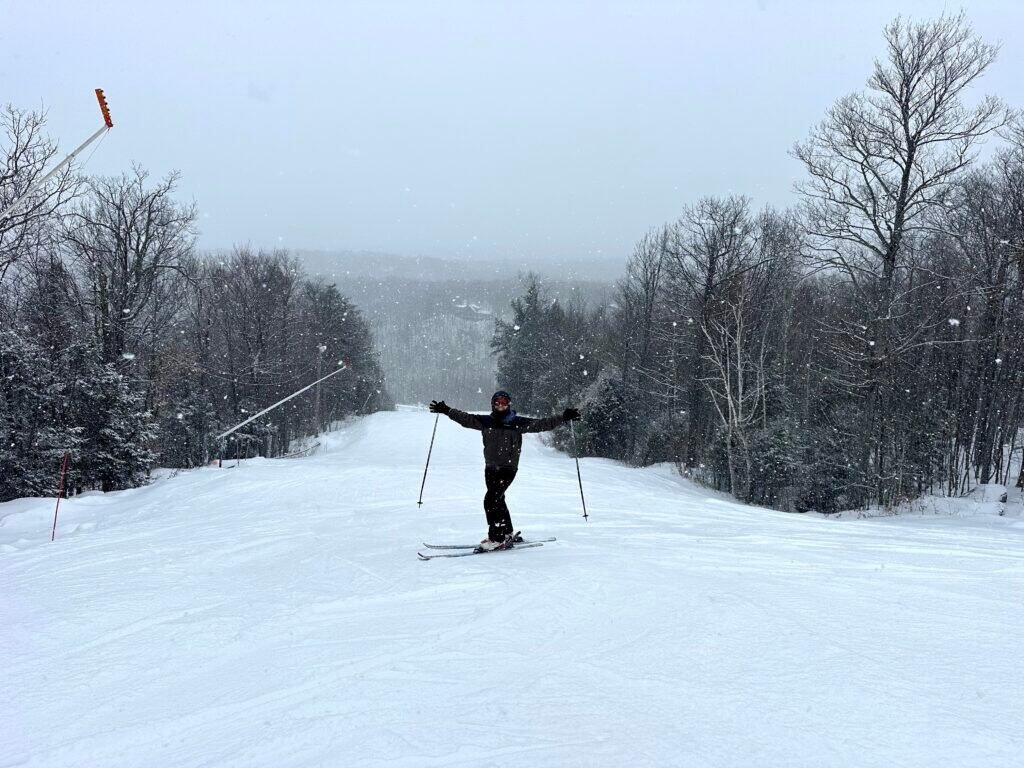
The Best Ski Poles at a Glance
Ski Poles Compared
| Pole | Best for | Type | Grip |
|---|---|---|---|
| LEKI Detect S | All-mountain, all conditions | Fixed, 110 to 135 cm | Trigger S, strap detaches |
| Atomic AMT | Everyday resort skiing | Fixed, 110 to 125 cm | Ergonomic AMT, adjustable strap |
| LEKI Bliss | Women, firm snow | Fixed, 105 to 125 cm | PAS V2 soft grip |
| LEKI Helicon Lite | Touring and backcountry | Adjustable, 110 to 145 cm | Extended foam grip |
| Rossignol Tactic | Budget downhill | Fixed, 110 to 135 cm | Bi-injected, damps vibration |
| LEKI QNTM | Hard snow and ice | Fixed, 110 to 135 cm | EVOCON soft grip |
| Rossignol Electra | Women on a budget | Fixed, 105 to 125 cm | Women’s smaller grip |
| 5th Element Shadow | First seasons | Fixed | Molded rubber, adjustable strap |
Ski Pole Size Chart
Flip the pole, grab it under the basket, check the elbow. If a shop isn’t handy, use this chart. Pole lengths come in 5 cm steps, so round down if you like to get low in your turns and round up if you stand tall and pole-plant a lot. I’m always a size under the chart.
| Skier height | Pole (cm) | Pole (in) |
|---|---|---|
| 4’9″ to 4’11” (145 to 150 cm) | 105 | 41 |
| 5’0″ to 5’1″ (151 to 155 cm) | 110 | 43 |
| 5’2″ to 5’5″ (156 to 165 cm) | 115 | 45 |
| 5’6″ to 5’7″ (166 to 170 cm) | 120 | 47 |
| 5’8″ to 5’9″ (171 to 175 cm) | 125 | 49 |
| 5’10” to 5’11” (176 to 180 cm) | 130 | 51 |
| 6’0″ to 6’1″ (181 to 185 cm) | 135 | 53 |
| 6’2″ to 6’3″ (186 to 190 cm) | 140 | 55 |
| 6’4″ and up (191 cm and up) | 145 | 57 |
The 8 Best Ski Poles

LEKI Detect S
The Detect S earns the top spot because it is the one pole here built for every kind of day: a beefy 16 mm aluminum tube, a Trigger S grip whose strap clicks off for the chairlift, and both powder and alpine baskets in the box. Swap the basket in the morning and the same pair works on a groomed run or a storm day. At 8.5 oz (241 g) for the 120 cm pole it is light without feeling flimsy.
The honest downside is that you pay for the strap system, and this listing often sits at a handful left in stock, so grab your size when you see it.
- Material
- aluminum (HTS 6.5)
- Diameter
- 16 mm
- Length
- fixed, 110, 115, 120, 125, 130 or 135 cm
- Grip and strap
- Trigger 3D ProG, Trigger Frame mesh strap (detachable)
- Baskets
- Big Mountain powder and Cobra alpine, both included
- Weight
- 8.5 oz (120 cm)
- Best for
- all-mountain skiers who ski every kind of snow
Atomic AMT
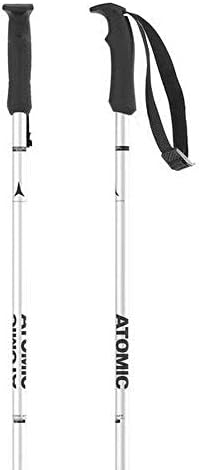
The Atomic AMT is the pole we’d hand a friend who wants a solid pair without thinking about it: high-tensile aluminum, an ergonomic all-mountain grip with ridges for a sure hold, and a simple strap that adjusts in seconds. It looks the part on any lift line and costs less than most of the poles here, in black, red or silver from 110 to 125 cm.
One thing to consider is that it is a basic pole: alpine basket only, a plain strap and no detachable grip, so if you ski deep powder often you’ll want the Detect S instead. Tall skiers need to look elsewhere too, because 125 cm is the longest it comes.
- Material
- aluminum
- Length
- fixed, 110, 115, 120 or 125 cm (the linked listing opens on 110 cm black; pick your length and color on Amazon)
- Grip and strap
- ergonomic AMT 1K grip, Essential strap with size adjustment
- Basket
- alpine
- Best for
- resort skiers who want one dependable pair

LEKI Bliss
The Bliss earns its spot as the women’s pole because LEKI built it in the lengths most women need, 105 to 125 cm, and kept it light: 7.5 oz (213 g) at 115 cm. The 16 mm aluminum tube is stiff and durable, the PAS V2 grip is soft and shaped for a smaller hand, and the small alpine basket is made for corduroy and firm snow.
Keep in mind the lengths stop at 125 cm, so taller women should look at the Detect S or QNTM, and the small basket sinks in deep powder.
- Material
- aluminum (TS 5.0)
- Diameter
- 16 mm
- Length
- fixed, 105, 110, 115, 120 or 125 cm
- Grip and strap
- PAS V2 soft grip, Lock Security nylon strap
- Basket
- alpine
- Weight
- 7.5 oz (115 cm)
- Best for
- women who ski groomed runs and firm snow

LEKI Helicon Lite
The Helicon Lite is the one pole here that changes length, from 110 to 145 cm with LEKI’s Speed Lock Plus, which is what you want when you climb on skins in the morning and ski down after lunch. The foam grip extends down the pole so you can choke down on steep switchbacks, and the Big Mountain Binding basket has a short edge to flip heel risers and a long edge to scrape ice off skins.
The trade-off here is at 9.2 oz (261 g) per pole it is the heaviest here, and a lock is one more part to check, so if you only ride lifts, buy a fixed pole and save the money.
- Material
- aluminum (HTS 6.5)
- Length
- adjustable, 110 to 145 cm, Speed Lock Plus
- Packed length
- 37 in (94 cm)
- Grip and strap
- extended foam grip, Lock Security nylon strap
- Basket
- Big Mountain Binding
- Weight
- 9.2 oz
- Best for
- ski touring, splitboarding and backcountry days
Rossignol Tactic
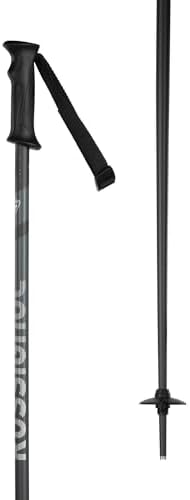
The Tactic is the budget pick because it gives you a Dural aluminum tube and a grip that actually does something: the bi-injected components absorb vibration coming up the pole, which your hands notice on hardpack by mid-afternoon. It is light, plain and does the job on resort runs, and it comes in grey, black or blue from 110 to 135 cm, so most adults find their length.
The downside is the plain part: a standard alpine basket, a basic strap and a fixed length, so measure twice before you order.
- Material
- aluminum (Dural tube)
- Length
- fixed, 110 to 135 cm in 5 cm steps (the linked listing opens on 125 cm grey; pick your length and color on Amazon)
- Grip
- bi-injected, vibration-damping
- Basket
- alpine
- Sold as
- pair
- Best for
- resort and downhill skiers on a budget

LEKI QNTM
The QNTM is the thickest pole on this list at 18 mm, which makes it the pole for skiers who plant hard on icy corduroy and don’t want to feel the pole flex back at them. It is LEKI quality at LEKI’s entry price: stiff aluminum, a soft EVOCON grip and an adjustable strap, with the alpine basket LEKI says is best on ice, corduroy and spring slush.
We have to mention one point about the thickness: at 8.3 oz (235 g) for 120 cm it is a touch heavier than the Bliss, and with only an alpine basket it is not a powder pole.
- Material
- aluminum (TS 5.0)
- Diameter
- 18 mm
- Length
- fixed, 110, 115, 120, 125, 130 or 135 cm
- Grip and strap
- EVOCON soft grip, Lock Security nylon strap
- Basket
- alpine
- Weight
- 8.3 oz (120 cm)
- Best for
- hard snow, ice and skiers who plant hard

Rossignol Electra
The Electra is the women’s budget pole because Rossignol shrank the one part that matters most: the grip, which has a smaller circumference and damps vibration, so a smaller hand holds it without squeezing all day. The Dural aluminum tube is the same strong, light tube as the Tactic, in white, black or blue from 105 to 125 cm.
The grip is the only women’s-specific part, and lengths stop at 125 cm, so check your size on the chart before you click.
- Material
- aluminum (Dural tube)
- Length
- fixed, 105, 110, 115, 120 or 125 cm (the linked listing opens on 120 cm white; pick your length and color on Amazon)
- Grip
- women’s-specific, smaller circumference, vibration-damping
- Basket
- alpine
- Sold as
- pair
- Best for
- women who want a light downhill pole without the price tag

5th Element Shadow
The Shadow earns the beginner’s spot because it comes with everything a first-season skier needs and nothing to fiddle with: a molded rubber grip with an adjustable strap, standard snow baskets, steel tips and a two-year warranty against defects. The matte black finish with a red accent looks sharper than most starter poles.
- Material
- aluminum, as the listing title and features state (Amazon’s spec table says composite)
- Length
- fixed
- Grip and strap
- molded rubber, adjustable strap
- Basket and tip
- standard snow basket, steel tip
- Warranty
- 2 years against manufacturing defects
- Best for
- first seasons and occasional skiers
How We Picked
Every pole here had to pass the three questions we ask of all our gear: will it last, does it feel good in the hand, and would we take it on our own trip? For poles, lasting means aluminum. A bent aluminum pole still gets you to the bottom, and I’ve already snapped one pole in my life, which is plenty. Feeling good means a grip you can hold all afternoon without squeezing and a strap that opens wide enough for a thick mitten. The trip question is the one that cut the list: we skipped the race poles, the pricey carbon and anything with a flimsy lock, and kept the pairs we’d put in our own ski bag.
That left a lot of LEKI, because LEKI puts more thought into grips and straps than anyone else at this price, plus Atomic and Rossignol for skiers who want a solid pair without the extras, one adjustable pole for touring and one starter pole for a first season. The full method is on our how we choose gear page.
What to Look For in Ski Poles
We look at length first: Use the chart above, then go one size shorter if you lean into sharp turns and one size longer if you stand tall and pole-plant on every turn. Honestly, a slightly short pole is rarely a problem; a long one knocks your rhythm off all day however.
Aluminum over carbon for most skiers: Aluminum bends when you crash on it and can often be bent back. Carbon is lighter but snaps instead of bending, and it costs more. All eight poles here are aluminum for that reason.
Grip and strap: A soft grip with an adjustable strap that fits over your glove is the baseline; our pick of ski gloves runs from thin leather to mittens, and the strap has to open wide enough for the thick ones. Detachable systems like LEKI’s Trigger S are a luxury you’ll miss on every chairlift once you’ve had them.
Baskets: Small alpine baskets are for groomed runs; wide powder baskets stop the pole from sinking to the grip in deep snow. Only the Detect S here ships with both.
How you carry them: Poles are the first thing to fall out of your arms in the parking lot. A simple ski strap clips skis and poles into one bundle, and a padded ski bag with a pole sleeve keeps them from scratching your bases on the drive or the flight.
Snowshoeing: Fixed alpine poles work fine for flat snowshoe walks, but if you snowshoe on hills, an adjustable pole like the Helicon Lite is better: shorten it for the climb, then lengthen it for the descent. Our snowshoes guide covers the rest of that kit.
FAQs
Turn the pole upside down, hold it under the basket and check that your elbow bends at about 90 degrees. By height, that works out to about 115 cm (45 in) for a 5’1. – 5’4″ skier, 120 cm (47 in) at 5’7″ and 130 cm (51 in) at 5’11”; the full chart is above. Go a size shorter if you carve low, a size longer if you stand tall and pole-plant. My sister is 5’2 and skis with 115cm poles.
Those curved poles are racing poles, bent to wrap around the body in a tuck so they create less drag in downhill and super-G. Straight poles are the right choice for everyone else, because you plant them hundreds of times a day and a straight pole plants cleanly. None of our picks is bent.
Ski poles time your turns, keep your upper body facing downhill and push you along flat sections and lift lines. You plant the pole lightly at the start of each turn, not to hold yourself up but to set the rhythm. They also get you back on your feet after a fall and clear snow off your bindings.
Adjustable poles are worth it if you tour, snowshoe or share poles between skiers; otherwise a fixed pole is lighter, cheaper and has no lock to fail. The Helicon Lite is the only adjustable pole on this list for that reason. For lift-served skiing, pick a fixed length from the chart.
Aluminum is the better choice for most skiers: it bends in a crash instead of snapping, and it costs less. Carbon saves a little weight on each swing, which matters most for racers and long touring days. Every pole here is aluminum, and a little flex in the pole feels good in a hard turn.
You can, but fixed alpine poles are the wrong length for most trails and their small baskets catch on roots. Hiking and trekking poles adjust, collapse into a pack and have rubber tips for rock; our guide to walking poles for hiking has the picks. The reverse works better: an adjustable ski pole like the Helicon Lite doubles as a trekking pole in summer.