
Ski straps are short Velcro or rubber bands that hold a pair of skis together, base to base, so they don’t slide apart, cross or scratch each other while you carry or store them. A typical Velcro ski strap is about 2 in wide and 19 in long (5 × 48 cm), light enough to fold into a jacket pocket, and long enough to wrap anything from narrow carving skis to wide powder skis.
We’ve skied all our lives, growing up in Canada, and we spent plenty of those years fumbling on the walk from the parking lot to the chalet: tips crossing, poles sliding out, bases grinding together. Ski straps fix that in seconds, in a simple, cheap way.
Here are the 7 ski straps we’d pick today: Velcro and rubber straps that hold your skis together first, then shoulder carriers that take the weight off your hands, plus how to choose and use them.

At a Glance
Ski Straps Compared
| Strap | Type | Hands-free | Best for |
|---|---|---|---|
| Fat Cookie | Velcro + foam pad | No | All-round |
| Titan Straps | Stretch rubber | No | Touring, repairs |
| Frienda | Velcro + foam pad | No | Budget, 6 pack |
| Shappy | Velcro + foam pad | No | Groups, 20 pack |
| Sklon | Shoulder sling | Yes | Long walks |
| Volk | Shoulder sling | Yes | Families, 2 pack |
| FIREOR | Sling + boot strap | Yes | Skis and boots |
The 7 Best Ski Straps

Fat Cookie Outdoors Ski Straps
A soft EVA foam pad between the skis makes these the most complete Velcro straps here: they hold the pair together and stop the bases rubbing and scuffing your wax. The strap is long enough to take your poles too, and it fits narrow carving skis through wide powder skis.
They fold small enough for a jacket pocket and weigh about an ounce. Like all Velcro, they grip less when packed with snow or ice, so knock them clean before you close them.
- Type
- Velcro with EVA foam pad
- Fits
- Narrow to wide skis, plus poles
- Weight
- About 1.1 oz (32 g)
- Best for
- Everyday resort skiing

Titan Straps
If you want the stretchy rubber type that backcountry skiers swear by, Titan Straps are the option on Amazon: a 25 in (64 cm) polymer strap with an aluminum buckle that you can thread through twice for extra hold. They cinch tight around skis in the cold and double as a repair strap for packs, poles or bindings.
They’re rated for a 60 lb working load and come as a 2-pack. Some buyers mention they stretch less than expected, so pull them firm rather than relying on the stretch.
- Type
- Stretch polymer strap, aluminum buckle
- Length
- 25 in (64 cm), 2-pack
- Strength
- 60 lb working load
- Best for
- Ski touring and gear repairs

Frienda 6 Pcs Ski Straps
Six padded Velcro straps in one low-cost pack make this the easy way to strap every pair of skis in the family. Each is 2 in wide and 18.9 in long (5 × 48 cm) with an EVA pad in the middle to protect the bases.
They come in mixed colors, which helps tell whose skis are whose on the rack. One buyer found them too long for narrow cross-country skis, so they suit alpine skis best.
- Type
- Velcro with EVA pad
- Size
- 2 × 18.9 in (5 × 48 cm), 6 straps
- Colors
- Red, black, blue
- Best for
- Families on a budget

Shappy 20 Pcs Ski Straps
Twenty straps in five colors make this the pick for ski clubs, school trips or a garage full of skis. They’re the same 1.97 × 18.9 in (5 × 48 cm) size as most Velcro straps, with an EVA pad to protect the bases.
The colors make color-coding easy. Some buyers say they feel cheaply made, so treat them as handy spares rather than a strap that lasts for years.
- Type
- Velcro with EVA pad
- Size
- 1.97 × 18.9 in (5 × 48 cm), 20 straps
- Colors
- Red, blue, yellow, green, black
- Best for
- Groups and spares

Sklon Ski Strap and Pole Carrier
A cushioned shoulder sling that carries your skis and poles hands-free makes the Sklon the best choice for long walks from the car or bus to the lift. It’s one of the most reviewed ski carriers on Amazon.
It’s especially handy for kids, who struggle to carry their own skis at the end of the day. It takes a minute to set up the first time, so practice at home.
- Type
- Shoulder sling for skis and poles
- Strap
- Cushioned shoulder pad
- Care
- Hand wash cold, air dry
- Best for
- Long walks to the lift

Volk Ski Carrier 2-Pack
Two adjustable shoulder carriers in one pack make the Volk the family pick: one for you, one for a child, with the length adjustable to fit little skiers. Each sling holds skis and poles together over your shoulder.
Check the contents when it arrives, as one buyer received a strap short. Otherwise it’s a simple strap-and-go system.
- Type
- Shoulder sling for skis and poles
- In the pack
- 2 carriers
- Fit
- Adjustable for adults and kids
- Best for
- Skiing with children
FIREOR Ski and Boot Carrier Kit
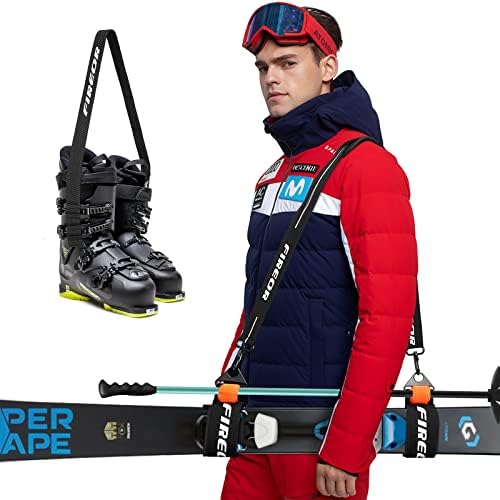
The only pick here with a separate boot strap, so you can carry skis, poles and boots in one trip. The ski sling adjusts for adults and kids, and the boot strap also works for ice skates.
It’s made from nylon with EVA padding. Some buyers say the pole loops don’t hold poles well, and one had a clip break, so it’s the pick for convenience rather than heavy use.
- Type
- Ski sling + boot carrier strap
- Material
- Nylon, EVA padding
- Fit
- Adjustable for adults and kids
- Best for
- Carrying skis and boots together
How We Picked These Ski Straps
We’ve carried skis since we were kids, so we know the problem these straps solve. For this guide we covered both main types, padded Velcro straps and stretchy rubber straps, then added shoulder carriers for longer walks. We checked each listing for size, materials and what buyers report after a season, and leaned toward straps lots of skiers already use.
What to Look for in Ski Straps
A ski strap is a small thing, but a few details decide whether it holds.
- Velcro or rubber. Padded Velcro straps protect your bases and are best for carrying and storing. Rubber straps grip in any weather and double as repair straps on tour.
- Length. About 19 in (48 cm) wraps most alpine skis. Very wide powder skis may need a longer strap; narrow cross-country skis a shorter one.
- A foam pad. A pad between the skis stops the bases and edges rubbing, which protects your wax.
- Cold and snow. Velcro grips less when it’s packed with snow or ice, so knock it clean. Rubber straps don’t have that problem.
- Straps or a sling. Straps keep the pair together; a shoulder sling also takes the weight off your hands for longer walks.
- The rest of your kit. For flights, pair your straps with a padded ski bag; for boots, see our ski boot bag guide; and our ski essentials guide covers everything else we pack for a ski day.
FAQs: Ski Straps
Yes, but check the length. Cross-country skis are much narrower, so long alpine straps can be loose; a shorter strap or a rubber strap you can cinch tight works better.
Padded Velcro straps are better for carrying and storing skis because the pad protects the bases. Rubber straps are better on tour: they grip in any weather and double as repair straps.
Put the skis base to base and clip the brakes together, then wrap one strap near the tips and, if you have a second, one near the tails. Pull it tight so the skis can’t slide apart.
Most do. A 19 in (48 cm) Velcro strap wraps most skis, and the Fat Cookie straps are made to fit wide powder skis; for very wide pairs, a longer 25 in (64 cm) rubber strap like Titan gives more room.
For the walk to the lift and short car trips, yes. For flights, use a padded ski bag and keep the straps on inside it.
Two per pair is ideal, one near the tips and one near the tails. One is enough for a short walk from the car.