
Women’s barefoot running shoes look almost too thin to run in, but with certain adjustments they can be made comfortable for training. A true barefoot running shoe has a wide toe box, a zero-drop sole and a thin, flexible base, so you feel the road or trail under you. The best ones add grip that suits where you run. They also hold your heel without squeezing your toes.
I wear barefoot shoes about 75% of the time, for walks, hikes and city days in the Austrian Alps. When it comes to barefoot running shoes, you don’t want them to be too flat, otherwise hard ground can feel a bit much for your feet and legs. Other components, such as a wide toe box, are still key.
Here are our 7 picks, led by the Xero Shoes HFS II, a true road running shoe with a 5,000-mile (8,000 km) sole warranty. The rest cover a knit road shoe, three trail runners, a toe shoe and a budget pair. For everyday pairs, see our best barefoot shoes for women.

Best Women’s Barefoot Running Shoes at a Glance
How the 7 Compare
| Shoe | Surface | Best for |
|---|---|---|
| Xero HFS II | Road | Road runs, training |
| Vivobarefoot Primus Lite Knit | Road, gym | Dry days, max ground feel |
| Xero Scrambler Low EV | Trail | Rocky, rooty trails |
| Vivobarefoot Primus Trail III AW FG | Trail | Wet and damp trails |
| Merrell Vapor Glove 6 | Trail, gym | Smooth trails, warm days |
| Vibram V-Run Retro | Road | A toe shoe for road runs |
| WHITIN Wide Toe Box | Road, walking | A first pair on a budget |
The 7 Best Women’s Barefoot Running Shoes

Xero Shoes HFS II
The HFS II earns the top spot because Xero built it as a road running shoe first. It has a wide toe box, a zero-drop heel and a tire tread-inspired sole that adds grip, even off-road.
At 6.7 oz (190 g), it’s the lightest Xero pick here. A thin foam layer in the sole adds a little protection underfoot. One thing to note is that it’s hand wash only, so it can’t go in the machine after a muddy run.
- Material
- rubber sole with a thin BareFoam layer, moisture-wicking lining
- Weight
- 6.7 oz (190 g) per shoe, women’s 7
- Drop
- 0 mm
- Sole warranty
- 5,000 miles
- Care
- hand wash, air dry
- Best for
- road running, everyday training

Vivobarefoot Primus Lite Knit
The Primus Lite Knit is the pick for the most ground feel on road runs and in the gym. Its sole is just 2 mm thick, with a hexagonal tread.
The knit upper is mostly TENCEL lyocell, a fiber made from wood pulp, and the insole is topped with cork. It weighs 6.6 oz (188 g) per shoe. We did notice that the knit isn’t water resistant, so it’s a dry-day shoe. The heel counter is leather, too, which is our preference. However, that means it isn’t a vegan pick. I went up to a US 8 in my Vivobarefoot pairs, from my usual US 7 or 7.5.
- Material
- upper 92% TENCEL lyocell, 7% hotmelt, 1% Roica; cork and recycled PU insole; natural rubber blend outsole; leather heel counter
- Sole
- 2 mm (0.08 in), hexagonal tread
- Weight
- 6.6 oz (188 g) per shoe, women’s US 7
- Water resistance
- none
- Best for
- road runs, gym sessions, everyday wear

Xero Shoes Scrambler Low EV
The Scrambler Low EV is the pick for trail runs on rocky and uneven ground. Xero calls it its most versatile trail shoe, with a Michelin Fiberlite outsole and grippy lugs.
The mesh upper resists scuffs and debris, and the shoe is free of animal products, so it suits vegan runners. At 7.4 oz (210 g) per shoe in a women’s 7, it’s still light for a trail shoe. One factor to consider is that it has no waterproof membrane, so wet feet come with a muddy run.
- Material
- abrasion-resistant mesh upper, Michelin Fiberlite outsole with embedded TrailFoam, free of animal products
- Weight
- 7.4 oz (210 g) per shoe, women’s 7
- Drop
- 0 mm
- Sole warranty
- 5,000 miles
- Care
- hand wash, air dry
- Best for
- trail runs, hikes, travel

Vivobarefoot Primus Trail III All Weather FG
The Primus Trail III All Weather FG is the pick for damp trail runs. Its water-resistant upper handles rain and wet grass, and firm-ground lugs grip dirt and gravel.
The men’s version of this shoe has been tested by us. Keep in mind that firm-ground lugs are made for dirt and gravel. They feel less at home on long stretches of pavement.
- Material
- recycled PET upper, mesh lining, rubber sole, insole made of 98% recycled polyurethane foam
- Sole
- firm-ground lugs, zero drop
- Water resistance
- water-resistant upper
- Best for
- wet trail runs, day hikes
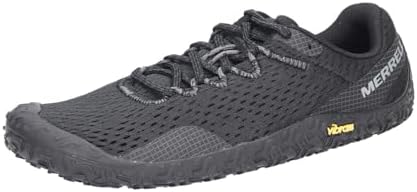
Merrell Vapor Glove 6
The Vapor Glove 6 is the pick for a very thin, flexible shoe on smooth trails. It’s made as a trail running shoe, and its Vibram EcoStep outsole lets you feel the trail clearly.
The recycled mesh upper breathes on warm days, and it works as a gym shoe too. We’d point out that so little sole means sharp rocks come through. It suits smooth paths more than rough ground.
- Material
- 100% recycled breathable mesh upper with TPU overlays, 100% recycled synthetic mesh lining, Vibram EcoStep rubber outsole, EVA insole
- Sole
- thin and flexible, zero drop
- Best for
- smooth trails, gym sessions, warm days

Vibram FiveFingers V-Run Retro
The V-Run Retro is the pick for a toe shoe on road runs. Each toe has its own pocket, and the XS Trek outsole is made for roads.
The breathable mesh upper keeps it light on warm days. One downside is the fit, because toe pockets don’t suit every foot. They also take a little longer to put on. If you are wearing socks, they would need to be toe socks to fit.
- Material
- breathable nylon mesh upper with a microfiber blend, Vibram XS Trek rubber outsole (4 mm), 2 mm foam insole with a polyester sockliner and EVA arch pad
- Toes
- individual toe pockets
- Best for
- road runs, runners who like a toe shoe
Our merino wool toe socks guide has pairs that fit a toe shoe.

WHITIN Wide Toe Box Running Shoe
The WHITIN Wide Toe Box Running Shoe is the budget way to try barefoot running. It has a roomy toe box and a zero-drop sole, and the maker sells it for walking and running.
It costs a lot less than the Xero, Vivobarefoot, Merrell and Vibram picks, so it’s an easy first pair. One thing we’d flag is that it comes from a lesser-known brand than others on our roundup. Plus it suits shorter runs better than long ones.
- Material
- breathable mesh upper with a moisture-wicking mesh lining, rubber outsole, lightweight EVA foam midsole, foam insole
- Sole
- zero drop
- Best for
- shorter runs, walking, a first barefoot pair
How We Picked
My husband loves trail running, and he will wear barefoot trail running shoes when running in nature. However, for road running you will need to pay more attention to your shoes. Barefoot and minimalist shoes are a big change from cushioned running shoes. That’s why we would start by walking or limiting them to a small percentage of your weekly mileage. Then work your way up. We picked shoes that were made specifically for road running and trail running, so they work with you and your performance rather than against you.
Every shoe here is a true barefoot shoe: wide toe box, zero-drop sole, thin and flexible base. From there, it came down to where you run. Road shoes need a smooth, light sole, and trail shoes need lugs that bite into dirt and rock. That gave us two road shoes, three trail runners, a toe shoe and a budget pair. You can read more about how we choose gear.
What to Look For in Women’s Barefoot Running Shoes
Toe box and fit: Your toes should spread without touching the sides, even at the end of a run. Sizing varies between brands, so check each brand’s size chart.
Sole and ground feel: A thinner sole lets you feel more of the ground. A little foam, like in the HFS II or Scrambler Low EV, takes the edge off gravel.
Road or trail: Road shoes have flatter tread for pavement, while trail shoes have lugs for dirt, mud and rock. My Vivobarefoot Trackers are a hiking shoe that could double as a trail runner. For them and other shoes made for long days on foot, see our barefoot hiking shoes for women.
Weight: A light shoe is easy to forget about on a run. The HFS II, Primus Lite Knit and Scrambler Low EV all come in under 7.5 oz (213 g) per shoe in a women’s 7.
Socks: A thin merino ankle sock is my pick with barefoot shoes. Our merino wool socks guide has the pairs I wear.
Shopping for him: Our barefoot running shoes for men guide has the men’s picks.
FAQs
Most people do. I wear thin merino ankle socks with my Vivobarefoot Trackers, and they’re the right length for the shoe and don’t rub. With a toe shoe like the V-Run Retro, you need toe socks or none at all.
They suit runners who like to feel the ground and want room for their toes. They feel very different from cushioned running shoes, so most people start with short, easy runs. If you have a foot condition, ask a podiatrist before you switch.
Yes, as long as the sole has lugs. The Scrambler Low EV, Primus Trail III and Vapor Glove 6 are all made for trails. A thinner sole means you feel rocks more, so smooth paths are the easiest place to start.
Often, yes, because your toes need room to spread. I’m normally a US 7 or 7.5 and went up to a US 8 in Vivobarefoot. Check each brand’s size chart, since sizing varies.
It depends on your miles and the ground you cover. Xero backs the soles of the HFS II and Scrambler Low EV with a 5,000-mile (8,000 km) warranty. The grip on my Tracker hiking shoes only started to wear down after many, many days of use.
Yes, most of these work for walks and the gym too. I wear barefoot shoes about 75% of the time, and the Primus Lite Knit and the WHITIN are the easiest picks here to wear around town. You can read how I switched to barefoot shoes.